Passover in Italy: an Insider guide for families and private groups
For many American Jewish families, planning Passover abroad begins with a very specific desire: not simply to travel, but to place the Seder in a setting that feels meaningful. Italy answers that desire in a way few destinations can. Here, beauty is never detached from history. In Rome, Venice, and beyond, Jewish life is not an isolated chapter preserved behind glass, but part of the country’s cultural fabric, still visible in neighborhoods, rituals, recipes, and memory.
That is precisely what makes Passover in Italy so compelling for private groups and multigenerational families. You are not choosing between heritage and comfort, or between spiritual depth and aesthetic pleasure. You are choosing a destination where a family celebration can feel historically grounded, culturally rich, and beautifully designed at the same time.
Yet the most successful Passover journeys in Italy are never improvised. Spring in Italy is one of the most desirable moments of the year, and it unfolds against a dense calendar of religious observances and national holidays. Easter, Easter Monday, and Liberation Day all shape availability, movement, and the rhythm of local life. In other words, a memorable Pesach in Italy requires far more than an attractive villa or a generous travel budget. It requires timing, cultural fluency, and very careful planning.
Why Italy feels so special during Passover
Italy offers something rare to Jewish travelers: a sense of continuity. Rome’s Jewish Community describes itself as the oldest in Europe, while the Jewish Museum of Rome speaks of two thousand years of Roman-Jewish history and its enduring bond with the city. That continuity is not abstract. It can be felt in the old Jewish quarter, in the view toward the Portico d’Ottavia, and in the emotional weight of places connected to both loss and resilience, including the Arch of Titus and the story of the Menorah carried to Rome after the destruction of the Temple.
For American families, that matters. A Passover trip should not feel like a resort week with symbolic touches added at the margins. It should feel coherent. In Italy, the setting itself can support the meaning of the holiday: freedom, memory, transmission, and the gathering of generations around a shared table.
There is also another, more practical reason Italy works so well. It is a country that understands family travel. Meals remain central, hospitality can be deeply personal when arranged well, and private service still has an old-world quality here. When a family wants a Seder that is elegant without being theatrical, organized without feeling rigid, and rooted in culture rather than generic luxury, Italy is often the right answer.
The real planning challenge: Pesach, Easter, and Italy’s spring calendar
This is the part many travelers underestimate. In Italy, spring is beautiful, but it is also busy. Easter Monday is an official public holiday, and April 25, Liberation Day, is one of the country’s national observances. Depending on the calendar year, Passover may fall close to these peak moments, creating pressure on hotels, drivers, guides, and rail travel.
For private groups, that matters immediately. A family of four can absorb a little improvisation. A group of fifteen or twenty cannot. If rooms are not secured early, your guests may end up scattered across different floors, wings, or even different properties. If transfers are not timed correctly, what should feel graceful can quickly become tiring. And if an itinerary ignores Pasquetta, the day Italians traditionally head out for countryside lunches and day trips, you may find yourself moving through a country that has collectively decided to go on an outing at the exact same moment.
This is why early planning matters so much. For premium hotels, heritage-rich city stays, and villas suitable for exclusive use, six to nine months is not excessive. For highly specific requirements around kosher dining, private space, and family-style hosting, more notice is often better.
The Italian settings that work best for private groups
Not every beautiful part of Italy is equally suitable for Passover. For a refined group experience, the destination must offer not only atmosphere, but also the right balance of access, privacy, and operational ease.

Rome: history with substance
Rome is the natural choice for families who want the strongest sense of Jewish historical continuity. The city offers depth, not just symbolism. A Seder here can be framed by serious heritage: the old Jewish quarter, the Great Synagogue, the museum collections, and a wider Roman landscape where Jewish history is inseparable from the history of the city itself.
It also works particularly well for groups because the infrastructure is stronger. There is a wider range of high-level accommodations, more possibilities for private guiding, and greater flexibility for arranging curated visits that feel scholarly rather than touristic. When done well, Rome is ideal for families who want both emotional resonance and urban sophistication.
And then there is the table. Spring in Rome means artichokes, and no serious conversation about Roman-Jewish cooking is complete without acknowledging how naturally the season aligns with Pesach cooking. Carciofi alla giudia are not a decorative local reference; they are one of those dishes that immediately place a traveler inside the cultural texture of Roman Jewish life.

Venice: intimacy, stillness, and atmosphere
Venice appeals to a different kind of group. It is not the obvious choice for every family, and that is exactly why it can be so special. The Venetian Ghetto, established in 1516, is presented by the City of Venice and related cultural institutions as the oldest in Europe, and is widely recognized as the first ghetto in the world. That history gives the neighborhood a gravity that is impossible to manufacture.
What Venice offers best is intimacy. The experience is more contained, more contemplative, and often more emotional. A family that values quieter time together, private water access, and a slower rhythm may find Venice more suitable than a large city stay. It is also one of the few places where a private water taxi is not simply a luxury flourish. For groups, it becomes a way to preserve cohesion, minimize fatigue, and move elegantly through a place that can otherwise feel fragmented by bridges and foot traffic.
Venice is especially effective for clients who want their Passover journey to feel reflective rather than expansive. It is less about covering ground and more about inhabiting a mood.

Tuscany: exclusive use and family rhythm
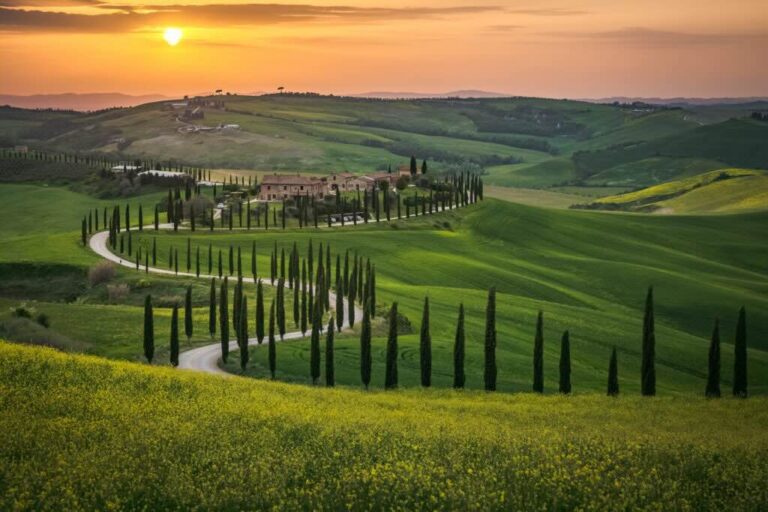
For multigenerational families, Tuscany often works best when the goal is not sightseeing first, but togetherness. The right estate offers something city hotels never can: control of pace, privacy, and the feeling that the holiday is unfolding in a home-like environment rather than around a hotel schedule.
This is where the phrase “luxury villa” can be misleading. Not every beautiful Tuscan property is suitable for Passover. The right one must have a kitchen that can be properly prepared, staff willing to work within clear requirements, dining spaces that support long shared meals, and enough layout flexibility for grandparents, children, and younger families to coexist comfortably. When those elements come together, Tuscany can be extraordinary.
It is also ideal for clients who want the Seder to feel personal. Some families prefer formality and scale; others want candlelight, long conversation, and an atmosphere that feels private rather than performative. In Tuscany, both are possible, but only with the right property and the right team behind it.
Designing a Passover table in Italy
One of the most common questions about Passover in Italy is whether the destination can truly support a serious holiday table. The answer is yes, but only when the planning respects both religious requirements and local reality.
Italy is often reduced, in the American imagination, to pasta and wine. In practice, much of Italian spring cooking lends itself surprisingly well to Passover menus. In the Roman Jewish tradition in particular, vegetables, fish, lamb, broths, artichokes, citrus, nuts, and almond-based preparations can form a table that feels seasonal, generous, and authentically Italian rather than like a compromise.
For families requiring stricter kosher-for-Passover standards, standard hotel banqueting is rarely the best route. A more reliable approach is to bring in specialized kosher catering or work with a trusted local partner under appropriate rabbinic supervision. That is where a trip either becomes seamless or begins to feel improvised. The difference is not visible in a brochure, but it is immediately visible at the table.
The most successful menus are usually the ones that do not try to imitate a generic luxury dinner. They lean instead into the elegance of restraint: very good ingredients, spring-forward dishes, polished service, and a rhythm that respects the holiday rather than interrupting it.
What makes a group journey feel seamless
Luxury group travel in Italy is often discussed in terms of hotels and views. In reality, what guests remember most is whether the trip felt easy. That ease is created by invisible decisions.
Transport is one example. During busy spring periods, relying on public trains for a holiday group is rarely wise. Private transfers and dedicated drivers are not about extravagance; they are about protecting the rhythm of the trip. The same applies to guide selection. A family visiting Rome for Passover does not need someone who can recite dates mechanically. They need someone who can explain, with intelligence and sensitivity, why these places matter to Jewish history and why Italy offers such a distinctive setting for that conversation.
Accommodation matters just as much. Shabbat-friendly layouts, walkable room configurations, discreet service, and staff who understand that family ritual takes precedence over hotel tempo all make a significant difference. The goal is never to make the trip feel over-managed. It is to make it feel calm.
Frequently asked questions about Passover in Italy
Is Italy a good destination for a Passover family trip?
Yes, especially for families looking for a balance of heritage, privacy, and cultural depth. Italy works best when the trip is designed around the holiday rather than treated as a standard spring vacation with a Seder added in.
Which destinations work best for private groups?
Rome, Venice, and Tuscany are usually the strongest options. Rome offers historical depth and stronger logistics, Venice offers intimacy and atmosphere, and Tuscany offers privacy and exclusive-use living for multigenerational gatherings.
Can a private Seder be arranged in Italy?
Absolutely. Private Seders can be arranged in villas, private dining rooms, and selected hotels, provided the property, kitchen, staffing, and kosher requirements are assessed well in advance.
How far in advance should a Passover trip to Italy be planned?
For high-level group travel, earlier is always better. Six to nine months is a sensible starting point, and even more time is advisable for families requesting exclusive-use properties or highly specific Passover requirements.
Is Easter Monday a national holiday in Italy?
Yes. Easter Monday is a public holiday in Italy, officially recognized at national level. It is commonly known as Pasquetta and is one of the busiest leisure-travel days of the spring season.