Italian wine resorts for Spa-focused executive retreats
An off-site works better when people leave clear-headed rather than worn out. That is why Italian wine resorts keep appearing on shortlists for US incentive trips and executive retreats, and why we place several of them on the table whenever a client wants a program built around wellness rather than a ballroom.
The best of these estates let a group hold a morning strategy session, move into a thermal circuit after lunch, and close with a private cellar dinner, all without a transfer in between. That mix is rare in a city hotel. A handful of Italian vineyard properties genuinely deliver it, and we have vetted them on both counts: the meeting function and the wellness capacity.
Why do vineyard estates work better than a standard business hotel for a retreat?
A vineyard estate changes the rhythm of a work trip because the layout removes the friction of a city program. Meeting rooms sit close to guest rooms, spa areas and dining spaces, so the day moves without shuttle buses or lobby waits between sessions.
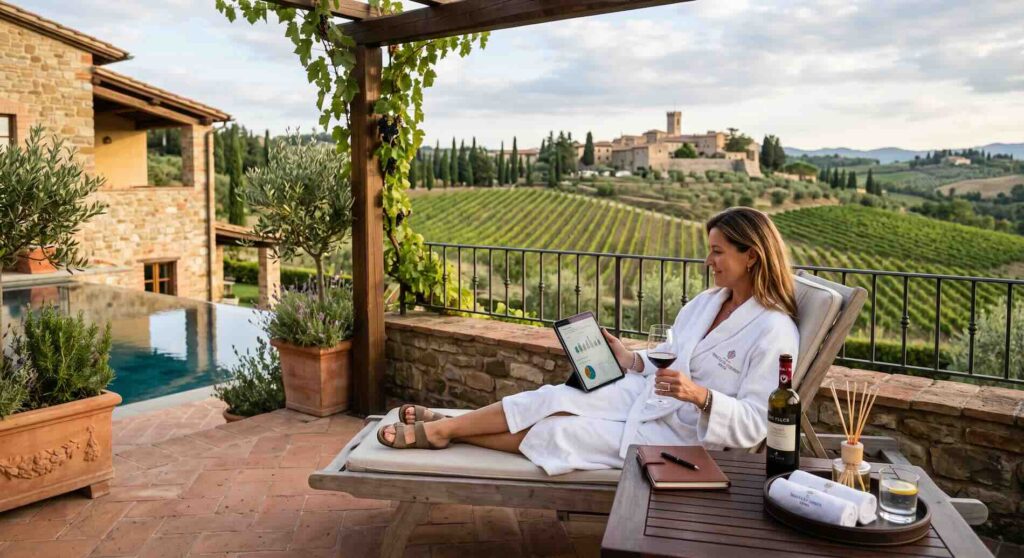
That matters most for senior teams. Long transfers and noisy urban schedules drain attention before the agenda even starts. A resort surrounded by vines gives a group privacy, quiet, and a built-in talking point, and the wellness side is the real differentiator: thermal water, grape-based treatments, a hammam, or simply unstructured time outdoors.
The social side lands better in wine country too. A hosted tasting or a slow lunch gives people time to talk without ballroom lighting or a forced icebreaker, which suits owner groups, client entertainment and leadership teams particularly well, since conversation keeps moving after the formal agenda ends.
Italy gives us range to match the brief. Tuscany reads as cinematic, Piedmont is more understated, and Veneto offers strong transport access with polished hospitality. We match the region to the group rather than defaulting to the most famous name. Our MICE and event planning team builds the agenda around whichever region fits the brief, and folds recovery time into the schedule deliberately, because tired guests make worse decisions on day two.
Which Italian vineyard resorts actually suit meetings and spa time?
The five properties below come up most often in our own proposals, because each pairs genuine meeting infrastructure with a wellness offering strong enough to carry a multi-day program.
Property | Region | Accommodation / meeting capacity | Best suited to |
|---|---|---|---|
Veneto | 15 meeting rooms across the villa and congress centre, up to 400 seats | Larger groups needing dependable AV and a full thermal spa on-site | |
Tuscany, Montalcino | 4 meeting rooms, 15 to 110 guests | Boards and top-client groups of 20 to 120 wanting a grand Tuscan arrival | |
Villa Sparina Resort (L’Ostelliere) | Piedmont, Gavi | Event space for up to 400; on-site pool, gym, massage and personal training on request | Groups wanting real scale plus genuine wellness amenities, without a dedicated thermal spa |
Castiglion del Bosco, a Rosewood Hotel | Tuscany, Val d’Orcia | 42 suites plus 11 private villas. | Large high-end groups drawn to two-Michelin-star dining and an on-site cooking school |
Castello Banfi (Castello di Poggio alle Mura) | Tuscany, Montalcino | 14-room boutique hotel. | Small, exclusive board-level groups, roughly 15 to 28 guests |
Villa Quaranta Tommasi, for larger groups that need both scale and spa
Villa Quaranta sits 20 minutes from both Verona and Lake Garda, with 15 meeting rooms across the historic villa and a dedicated congress centre, scaling from boardroom sessions up to 400 seats. The Terme della Valpolicella spa runs alongside it, so a group can move between a plenary session and a thermal circuit without leaving the property. This is the property we propose most often when the group is large enough that spa capacity, not just spa quality, becomes the constraint.
Castello di Velona, for a smaller group that wants the Tuscany arrival
Castello di Velona sits above Montalcino with 45 suites and four meeting rooms ranging from 15 to 110 guests, with the main room and restaurant able to combine for plenary sessions up to around 100. It suits boards and top-client weekends of 20 to 120 people who want a resort that reads as unmistakably Tuscan on arrival, backed by a genuine thermal spa rather than a spa in name only.
Villa Sparina, for real scale near the Ligurian border
Villa Sparina Resort, run through the Ostelliere hotel in Monterotondo di Gavi, sits in Piedmont’s Gavi wine country close to the Ligurian border, and it is built for conferences and congresses at scale, with event space for up to 400 guests. Rooms mix antique furniture with modern textiles, and the property runs an outdoor pool, a gym with an on-request masseur and personal trainer, a park with a solarium, and its own cooking, wine and yoga courses. It is not a thermal spa resort in the way Villa Quaranta or Castello di Velona are, but the wellness amenities are genuine rather than nominal, which makes it a strong fit for a large group that still wants downtime built in.
Castiglion del Bosco, for Michelin dining at scale
Castiglion del Bosco, a Rosewood hotel on a wine estate in the Val d’Orcia, holds 42 suites and 11 private villas, enough to house a sizeable group without doubling up. The estate’s dining includes the two-Michelin-star Campo del Drago, alongside a cooking school that gives non-drinkers and food-focused guests something central to the program rather than a side activity. Meeting-room figures aren’t published, so we confirm capacity directly with the property before proposing it for a session-heavy agenda; it earns its place on this list on accommodation and dining alone.
Castello Banfi, for a small group and a genuine piece of history
Castello di Poggio alle Mura, the medieval castle at the heart of the Banfi wine estate, dates to between the 9th and 13th centuries on a site occupied since Etruscan times. The Mariani family bought it in 1983 and folded it into Banfi’s roughly 3,000-hectare estate, which includes over 170 hectares planted to Brunello. The castle itself houses the winery; the adjoining 18th-century stone hamlet holds a 14-room boutique hotel, small enough that it suits a board-level group rather than a full incentive trip. Guests get a pool and fitness area with estate views, two restaurants including the Michelin-starred La Sala dei Grappoli, and a Museum of Glass and Bottle with pieces dating to Roman times, an unusual activity for an afternoon between sessions.
What should a US planner verify before booking a wine-country retreat?
This is the checklist we work through with every wine-country proposal before it goes to a client.
- Meeting setup. Room size, daylight, built-in AV, private dining options, and whether the property can run breakouts without moving the group across the estate all day. If privacy matters, ask about a full buyout or a guaranteed exclusive-use zone.
- Wellness capacity, not just the spa menu. A group of 40 needs enough treatment slots, thermal access and changing space to keep the schedule moving. Without that, the spa becomes the bottleneck that undoes the calm the retreat was built for.
- Access. A long coach transfer after an overnight flight can flatten the mood before the welcome dinner. For groups landing from the US, we often build overnight in a gateway city before the vineyard transfer, which makes the whole program feel lighter.
- Season. Harvest, typically September into October, is genuinely magical, but it also raises rates and tightens availability well in advance. Shoulder months either side often suit executive groups better: the countryside still looks the part, and the service isn’t stretched by the harvest crowd.
- Non-drinkers. Not every guest drinks wine. A program that gives non-drinkers equal value through cooking classes, olive oil tastings, a thermal circuit, guided walks or simple downtime keeps the trip inclusive, which matters whenever the guest list mixes executives, partners and clients.
Frequently asked questions
How many guests can a wine-country resort in Italy typically host for meetings?
It varies widely by property. Villa Quaranta in Veneto scales to 400 seats across its congress centre, while a smaller estate like Castello di Velona in Tuscany tops out around 100 to 120. We match the venue to the group size rather than the other way round.
Is harvest season the best time for an executive retreat in wine country?
It’s the most atmospheric, but not always the most practical. Harvest, roughly September into October, brings higher rates and tighter availability, and service can feel stretched. The shoulder months either side often work better for a group that needs the spa and meeting space to run smoothly.
Can a wine resort accommodate guests who don’t drink wine or prefer not to attend tastings?
Yes, and it matters to plan for it. We build in cooking classes, olive oil tastings, thermal circuits and guided walks so non-drinkers have equal value in the program rather than sitting out the signature activity.
Should we visit the property before booking a group retreat?
For groups above roughly 40, or any program where the wellness component is central, we recommend it, and we can arrange a site visit as part of the planning process rather than asking you to evaluate the property from a listing alone.
Plan your wine-country retreat
Tell us your group size, how central wellness is to the brief, and roughly when you’re looking to travel, and we will shortlist two or three properties that genuinely fit rather than send you a generic list to sort through yourself.